
You probably don't need guards
on the whole house.
Most houses around here don't have tree cover on every side. If your oaks are all out front, the back runs may never need covering. We'll walk it with you and point out which runs are actually catching debris — and if you want the whole house done anyway, that's your call to make, not ours.
Four things and we'll call you back. Days, usually within the hour.
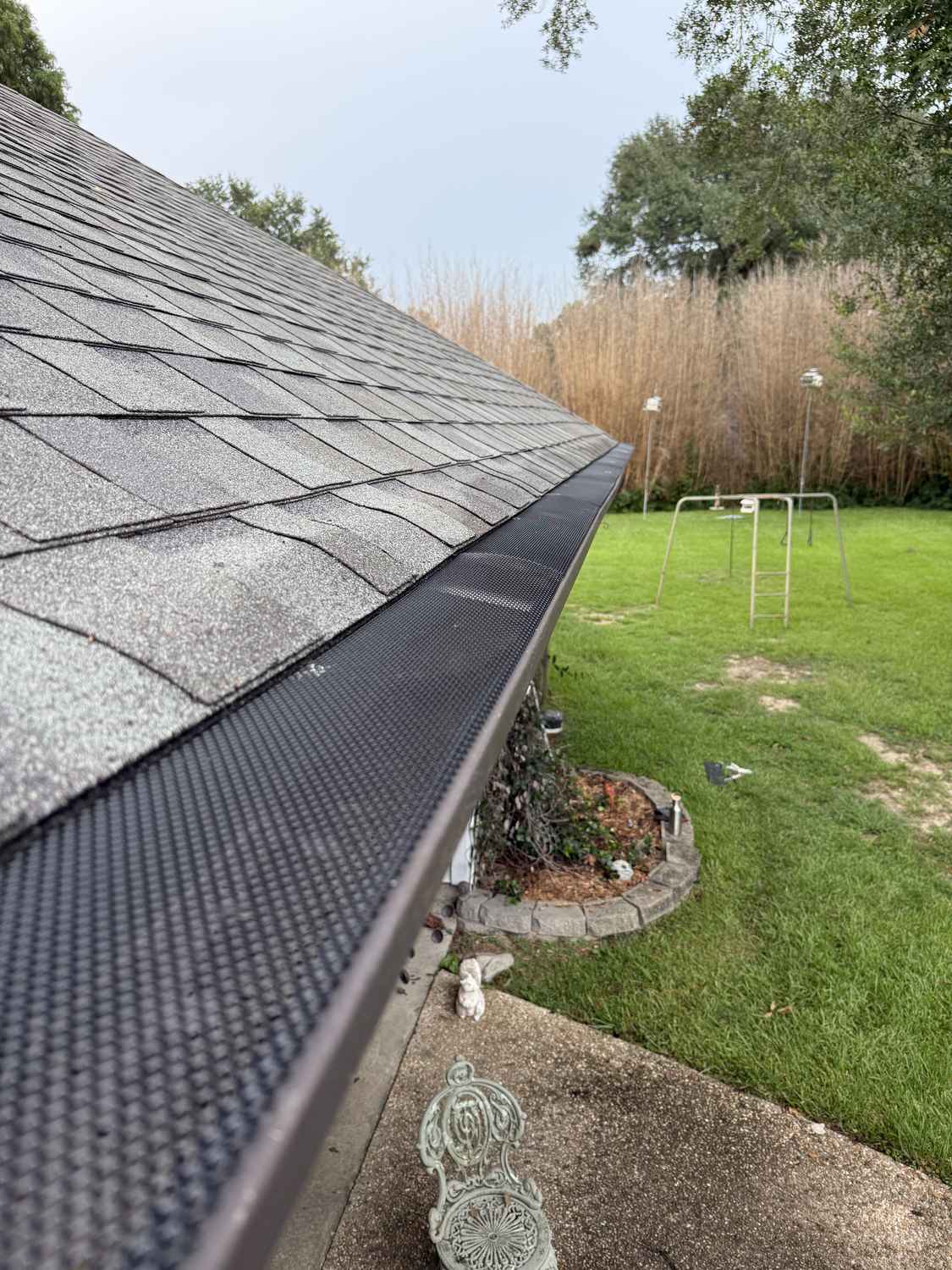
Guards where you need them. Not where you don't.
The gutter guard industry sells whole-house systems. That's how the pricing works, and it's why the numbers get big. But a house is not evenly covered by trees.
Where the trees actually are
Which sides sit under canopy, how close, and what species. Two live oaks out front and a clear back yard means the front runs are the problem and the back ones may be fine.
What's already collecting
I get up there and look in the gutters. The runs that are packed tell you where the debris goes. The runs that are clean after a season have been telling you something too.
Roof pitch and how it drains
A valley dumping onto one run changes the answer. So does a shallow pitch that holds debris instead of shedding it. Sometimes a run with no tree over it still needs covering because everything upslope funnels into it.
Most gutter jobs here come in under $2,000.
Not because we cut corners — because most houses don't need every run covered. Yours depends on how much footage you have and how much of it is actually under trees, and I can't know that until I look.
If you want the whole house wrapped and guarded, I'll quote that too and it will cost more. I'd just rather you decide that knowing what you actually need, instead of being told it's the only option.
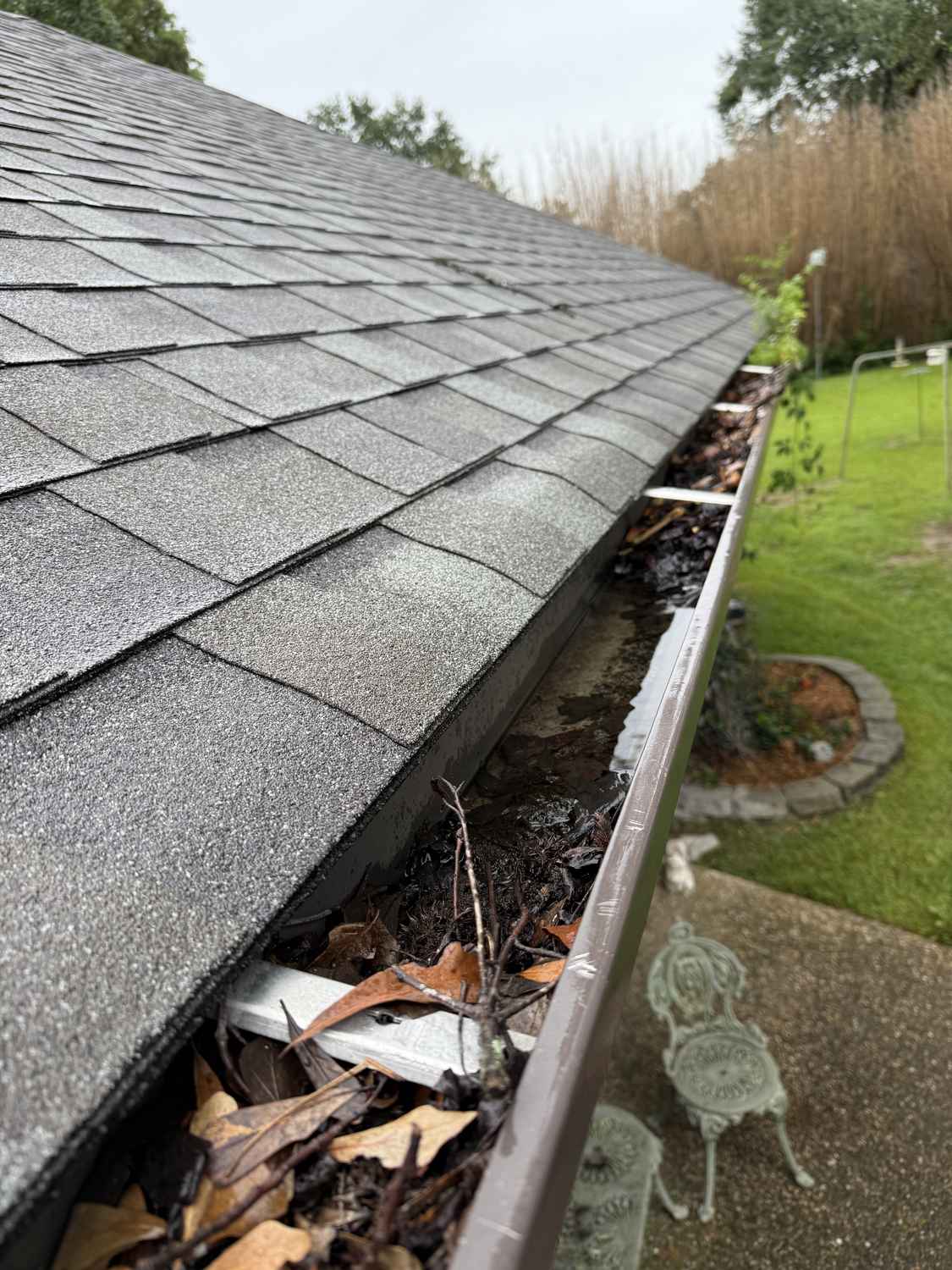
We rebuild the gutter before we cover it.
This is the part that separates a guard job that lasts from one that fails in two years, and it's the part most companies skip because you can't see it once the guard is on.
A guard is a lid. Putting a lid on a gutter that's clogged, leaking, or sagging just seals the problem in where you can't reach it. So before a single guard goes on, all of this happens — and it's included, not an add-on line on your quote:
- Every gutter and downspout cleaned out completely. By hand, not blown around. Debris bagged and hauled off.
- Water tested for flow. We run water through every run and watch where it goes. A gutter that pools instead of draining gets re-pitched before anything else happens.
- All seams and end caps resealed. Old sealant fails from the inside out. Every joint gets redone while we have clear access to it.
- Additional hangers added. Guards add weight, and Louisiana rain adds a lot more. We add support so the run doesn't pull away from the fascia in three years.
- Then the guard goes on. Fitted to the gutter you now have — clean, sealed, draining and properly supported.
If we find something we can't fix as part of the job — soft fascia, a run that needs replacing — we'll show you the photo and price it separately. What we won't do is cover it up and hand you an invoice.
The right guard depends on what's falling on your roof.
A house under pines has a completely different problem than a house under live oaks. We carry several systems so the product can fit the house, instead of fitting the house to whatever's on the truck.
Why this page talks about materials instead of brand names
Because the material is what determines how a guard performs. Mesh opening size, metal gauge, how the frame sits against the shingle — that's physics, and it's the same physics no matter whose sticker is on the box.
Brand names mostly tell you who has the bigger advertising budget. Compare the materials and you're comparing the thing that actually keeps needles out of your gutter in March.
You'll know exactly what's going on your house before we start — the specific product is written on your quote, along with the warranty that comes with it. We just don't think the name is where you should start.
The four kinds of gutter guard, honestly described.
Including what each one is bad at. Every type on this list has a house it's right for and a house it's wrong for.
Micro-mesh — fine screen
A very fine stainless or aluminum mesh over a frame. The tightest filtration available, which is what it takes to stop pine needles, live oak catkins and shingle grit.
Good: handles the small debris nothing else stops; fits over most existing gutters.
Trade-off: most expensive per foot, and the mesh can glaze over with pollen or grit and need an occasional rinse.
Perforated aluminum — punched metal
Solid aluminum with punched holes. Sturdier than screen and cheaper than micro-mesh, with openings big enough to pass water fast in a hard rain.
Good: strong, handles heavy rain volume well, sensible middle of the road on price.
Trade-off: pine needles can still work through the holes. Not the answer under heavy small-debris trees.
Screen guard — open mesh
A simple mesh or expanded-metal screen. The least expensive real option, and genuinely enough on a house with light tree cover.
Good: lowest cost per foot by a wide margin; keeps out leaves, twigs and roof debris.
Trade-off: small debris passes straight through, and lighter versions can sag or pop loose over time.
Reverse curve — solid cover
A solid hood that uses surface tension to pull water around a curved lip and into the gutter while debris slides off the edge.
Good: sheds leaves well, very durable, nearly invisible from the ground.
Trade-off: can overshoot in the kind of downpour we get here, and often needs to be fitted to the roof rather than just the gutter.
Six things I look at before I tell you anything.
This is the twenty minutes. None of it can be done over the phone, and none of it is a sales pitch — it's just what determines the answer.
What's over your roof
Pines and live oaks are the hard cases. Needles and catkins are small enough to pass through anything but the finest mesh. A yard with two crepe myrtles is a different conversation entirely.
Roof pitch
A steep roof throws water fast and far. That's where reverse-curve systems overshoot in a hard Louisiana rain, and where the guard has to be chosen for water volume, not just debris.
Gutter size and condition
Five-inch and six-inch gutters take different products. If your fascia is soft or the runs are pitched wrong, that gets fixed first — no guard fixes a gutter that isn't hanging right.
Sun and shade
A shaded north or back run stays damp, grows algae and holds debris longer. Sometimes only part of a house needs the premium system, and I'll tell you that instead of quoting the whole perimeter.
How the water leaves
Guards move the problem downstream. If your downspouts are undersized or dumping against the slab, we deal with that too, or you've bought a cleaner gutter and the same wet foundation.
What you're trying to solve
Tired of the ladder? Water over the front door? Foundation staying wet? Those point at different products — and occasionally at no guard at all, just a cleaning schedule.
Sometimes the right answer is the cheap one.
If you've got light tree cover and you're mostly tired of climbing a ladder twice a year, a screen guard will do the job and you should not spend three times that on micro-mesh. I'll tell you so, and I'll put it in writing.
And sometimes the right answer is no guard at all. If your gutters are hanging badly or your fascia is going soft, putting a guard on top of that is spending money to hide a problem that's going to get worse. We fix the gutter first, or we don't do the job.
What I'd put on my own house in Gonzales: I'll tell you in person, standing under your trees, looking at your roof. It depends on the house — which is the whole point of this page.
Straight answers.
Do gutter guards actually work?
Can you install guards on my existing gutters?
Will they handle pine needles?
What about live oak catkins in the spring?
What brand of gutter guard do you install?
How long is my quote good for?
Do I still need to clean my gutters?
Get My Free Estimate
Fill this in and we'll call or text you back — usually within the hour during the day.
Four parishes, one phone number.
Ascension Parish
Livingston Parish
East Baton Rouge Parish
West Baton Rouge Parish
Let's figure out what your house needs.
I'll look at your trees and your roofline, then text you a written price within 24 hours. Good for 30 days.